
The Tropic of Cancer is one of the most critical imaginary lines on Earth, playing a foundational role in defining our planet’s climate zones, seasonal shifts, and geographical boundaries. Sitting in the Northern Hemisphere, this specific parallel of latitude marks the boundary where the tropical zone ends and the subtropical zone begins.
In this comprehensive guide, we will break down the exact geography of the Tropic of Cancer, list every country and Indian state it crosses, and analyze how it shapes weather systems across the globe.
What is the Tropic of Cancer? (Definition & Latitude)
The Tropic of Cancer is a major circle of latitude located at approximately 23°26′ North of the Equator. It represents the northernmost point on Earth where the Sun can appear directly overhead at its zenith (noon).
This astronomical phenomenon happens exactly once a year during the June Solstice (typically on June 20th or 21st). On this day, the Northern Hemisphere receives its maximum solar radiation, marking the official start of astronomical summer for half the planet.
Why is it called “Cancer”?
The naming dates back thousands of years to ancient Babylonian astronomy. When the line was mapped, the Sun was entering the zodiac constellation of Cancer during the June solstice. Due to a slow shifting of Earth’s rotational axis known as axial precession, the Sun actually passes through the constellation Taurus during the modern June solstice, but the historical name remains unchanged.
Countries Through Which the Tropic of Cancer Passes
The Tropic of Cancer spans nearly 36,788 kilometers across the globe. On its journey around the Earth, it passes through 17 countries across three major continents, as well as several vast bodies of water like the Atlantic Ocean, Pacific Ocean, Red Sea, and Gulf of Mexico.
Here is the complete list of continents and countries positioned along the latitude line:
| Continent | Countries Crossed |
|---|---|
| 🌎 North America | Mexico, The Bahamas |
| 🌍 Africa | Western Sahara, Mauritania, Mali, Algeria, Niger, Libya, Egypt |
| 🌏 Asia | Saudi Arabia, United Arab Emirates (UAE), Oman, India, Bangladesh, Myanmar, China, Taiwan |
Regions situated along this line experience exceptionally high solar exposure, which heavily influences their seasonal agricultural cycles and local time structural standards. Because these regions sit right at the boundary of massive global wind patterns, tracking regional time variations becomes crucial for international travel and logistics across Asian territories. If you are tracking regional time zones or looking into precise time metrics across South Asian territories, you can easily view the current Indian Standard Time (IST) to see how local clocks align with these highly exposed geographical regions.
States of India Through Which the Tropic of Cancer Passes
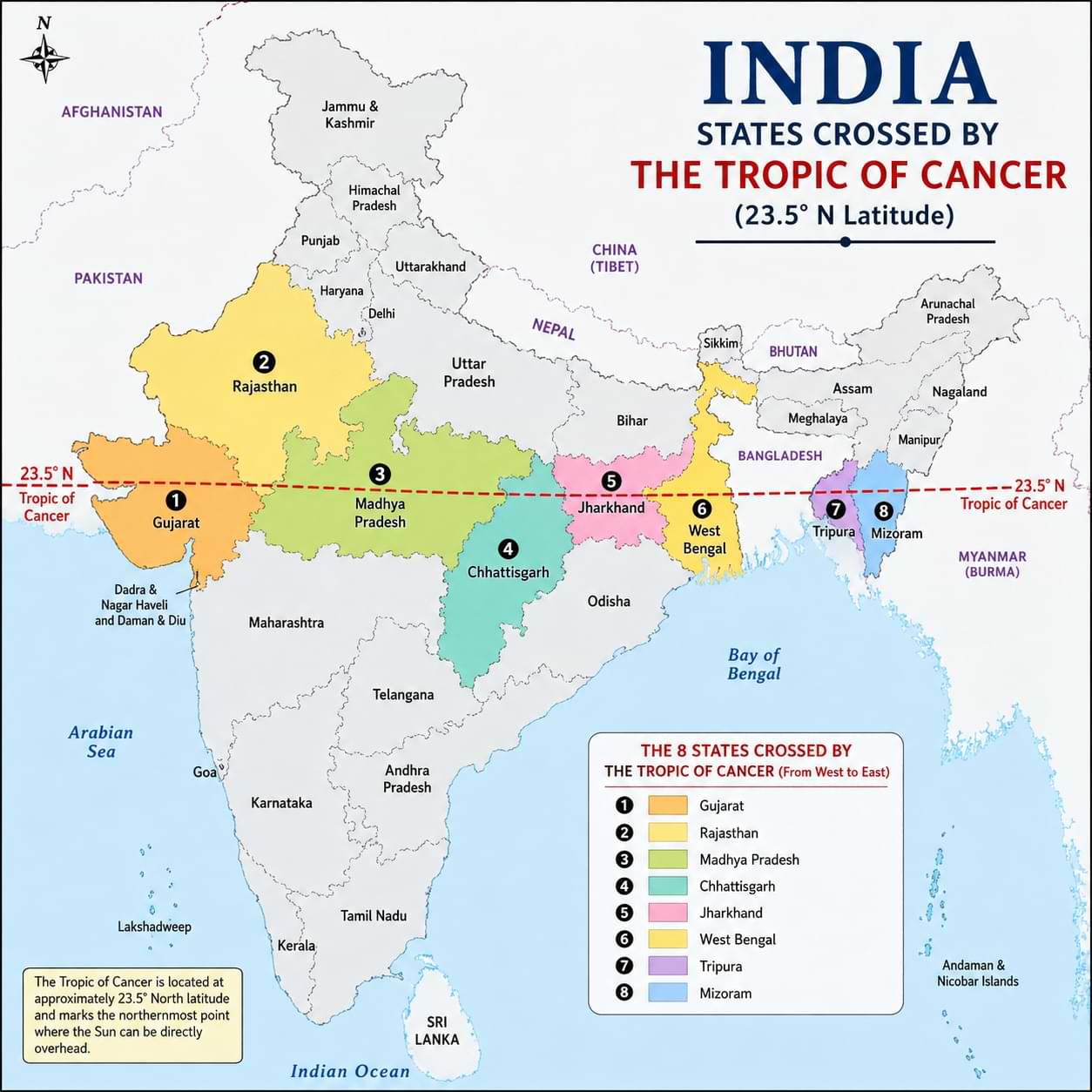
In South Asia, the Tropic of Cancer cuts almost perfectly through the midsection of India, effectively splitting the subcontinent into a tropical southern half and a subtropical northern half.
The line moves from West to East, passing directly through 8 Indian states:
-
Gujarat (Where it enters via the Rann of Kutch)
-
Rajasthan (Crossing a brief southern tip)
-
Madhya Pradesh (Passing through the longest stretch in India)
-
Chhattisgarh
-
Jharkhand (Famously crossing right through Ranchi)
-
West Bengal
-
Tripura
-
Mizoram
Geographical Fact: The Mahi River is the only river in India that cuts across the Tropic of Cancer twice—first on its northern path through Madhya Pradesh, and again as it turns south into Gujarat.
Read: What do am and pm mean?
Climatic Variations Along the Latitude
While you might expect everything along a single line of latitude to share the same weather, the geography along the Tropic of Cancer produces wildly different environments. Variations in mountain ranges, ocean currents, and pressure systems create three distinct climate zones:
1. Arid Desert Climate (North Africa & Middle East)
In regions like North Africa (the Sahara Desert) and the Middle East (the Arabian Desert), the Tropic of Cancer sits directly beneath a constant zone of sinking air known as the subtropical high-pressure belt. This high pressure suppresses cloud formation, creating some of the hottest, driest, and most inhospitable desert regions on Earth.
2. Tropical Monsoon Climate (South & Southeast Asia)
As the line moves into India, Bangladesh, and Myanmar, the climate shifts drastically due to seasonal winds. Instead of a permanent desert, these regions experience intense monsoon seasons. The extreme solar heating of the landmass in May and June draws in moisture-heavy air from the Indian Ocean, resulting in massive torrential downpours that feed major agricultural hubs.
Visualize Global Time Differences
Need to see exactly where the lines are drawn? Check out our interactive map to view every standard and daylight saving time zone at a glance.
3. Humid Subtropical & Temperate Climate (East Asia & Mexico)
In the highlands of Mexico and parts of Southeastern China, altitude and proximity to warm ocean currents soften the heat. These areas feature distinct wet and dry seasons with milder temperatures, supporting rich biodiversity, dense forests, and heavy cultivation of cash crops like sugarcane and tea.
Frequently Asked Questions
Everything you need to know about the Tropic of Cancer