If you’ve ever set an alarm for 12:00 PM thinking it was midnight, only to sleep right through your morning plans, you know that the 12-hour clock can be deceptively tricky.
While we use these two-letter abbreviations every single day, their origins trace back thousands of years to ancient Rome. Here is the exact breakdown of what AM and PM mean, how to use them correctly, and why 12:00 always confuses us.
The Definition: What Do AM and PM Mean?
The abbreviations AM and PM are derived from Latin phrases that divide our 24-hour day into two distinct literal blocks based on the position of the sun.
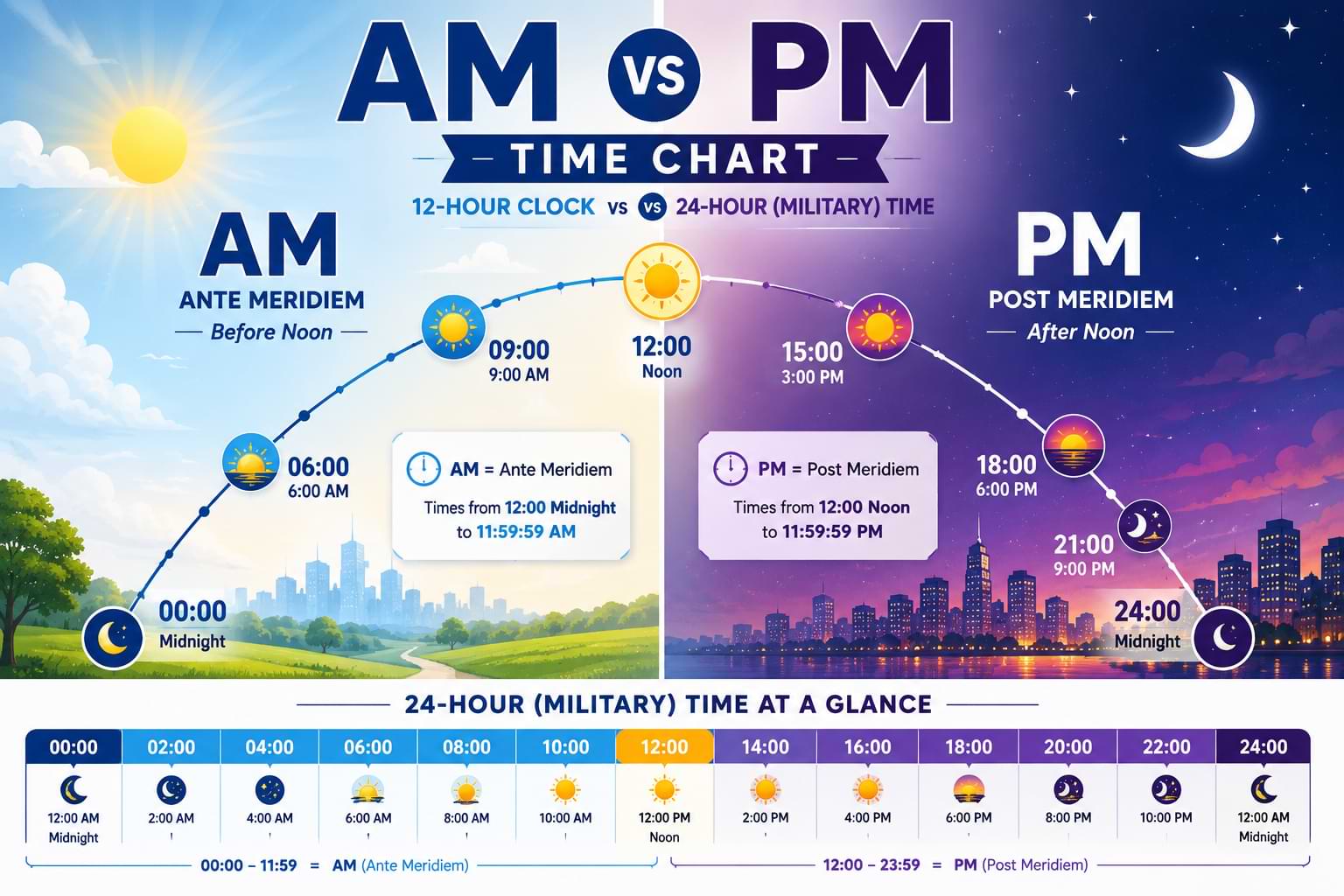
AM stands for Ante Meridiem, which translates to “before midday” or “before noon.”
PM stands for Post Meridiem, which translates to “after midday” or “after noon.”
They divide the 24 hours of the day into two 12-hour periods. The first 12-hour period runs from midnight to noon (AM). The second period runs from noon to midnight (PM).
Why 12:00 AM and 12:00 PM Are So Confusing
In my years of managing schedules and digital calendars, I’ve found that the absolute biggest point of failure for most people is midday and midnight.
Strictly speaking, the exact moment of noon is neither ante (before) nor post (after) meridiem—it is the meridiem (midday). Because of this linguistic quirk, using AM and PM at exactly 12 o’clock is technically improper, which is why it causes so much confusion.
To keep your digital calendars and invites flawless, follow this universal standard:
-
12:00 PM is Noon: Think of it this way: the minute after 12:00 noon is 12:01 PM (after noon). Therefore, the entire hour is treated as PM.
-
12:00 AM is Midnight: The minute after midnight is 12:01 AM (before noon). Therefore, the midnight hour is treated as AM.
How to Easily Memorize AM vs. PM
If you didn’t grow up using the 12-hour clock, memorizing Latin phrases isn’t going to help you in a pinch. Instead, use the Alphabet Rule:
-
AM comes first in the alphabet. It signifies the start of the day (Morning).
-
PM comes later in the alphabet. It signifies the later part of the day (Afternoon/Night).
Because A matches the beginning of both the alphabet and the daytime cycle, you will never mix them up again.
AM vs PM Time Conversion Chart
| Time of Day | 12-Hour Format | 24-Hour (Military) Format | Literal Meaning |
|---|---|---|---|
| Midnight | 12:00 AM | 00:00 hrs | Start of the day |
| Morning | 8:00 AM | 08:00 hrs | 8 hours before noon |
| Noon | 12:00 PM | 12:00 hrs | Midday / Solar Noon |
| Evening | 8:00 PM | 20:00 hrs | 8 hours after noon |
Fan-Out Queries: Common Time Questions Answered
Is Midnight the Start or End of a Day?
Technically, 12:00 AM (midnight) is the exact start of a new calendar day. If an assignment is due on “Friday at 12:00 AM,” it means the very first second after Thursday night ends.
💡 In My Testing & Professional Experience: If you are writing a deadline for business contracts, travel itineraries, or school assignments, never use 12:00 AM. Instead, write 11:59 PM on Thursday or 12:01 AM on Friday. This completely eliminates human error and potential legal or scheduling misunderstandings.
Where in the World is the 12-Hour Clock Used?
While the 24-hour clock is the default global standard, the 12-hour AM/PM convention remains deeply rooted as a matter of convenience and easy pronunciation (it is much faster to say “6 PM” than “18 hours” in casual conversation).
The AM/PM system is primarily used in English-speaking nations and historical territories of the former British Empire, including:
-
North America: United States, Canada, Mexico
-
Europe & Oceania: United Kingdom, Ireland, Australia, New Zealand, Malta
-
Asia & Africa: Egypt, Bangladesh, Malaysia, The Philippines, India
The Legal Problem with AM and PM (ISO 8601)
Because 12:00 AM and 12:00 PM cause massive human error in contract deadlines, travel itineraries, and international shipping, major legal and technical entities have actively banned them from formal documentation.
⚖️ The Global Standard: The International Organization for Standardization (ISO 8601) mandates that all formal data exchanges, legal contracts, and high-precision communication must use the 24-hour clock format to eliminate AM/PM ambiguity entirely.
If you are writing a legal document, managing an international corporate calendar, or scheduling military operations (where a mistake in radio communication could be catastrophic), stick strictly to 24-hour military notation. Save AM and PM strictly for your casual, informal texts and wristwatches.
Read: How to Convert PM to Military Time?
Quick Capitalization & Formatting Guide
When writing a blog post, book, or email, you might wonder how to format these abbreviations. According to major style guides (like AP, Chicago, and MLA):
-
Lower-case with periods (a.m. / p.m.): This is preferred by the AP Stylebook (e.g., “The meeting is at 10:30 a.m.”).
-
Small Capitals (AM / PM): Often used in typography and digital design for a cleaner look.
-
Space spacing: Always put a space between the number and the abbreviation (e.g.,
8 PM, not8PM).
Frequently Asked Questions: AM vs. PM Decoded
Everything you need to know about the AM vs. PM system
Is 12:00 PM Noon or Midnight?
Is 12:00 AM Noon or Midnight?
Does 12:00 AM Belong to Today or Tomorrow?
Why Do Airlines and Contracts Avoid Using 12:00 PM and 12:00 AM?
What is the Difference Between 24-Hour Time and Military Time?
08:00 in standard 24-hour time, but written as 0800 (pronounced “zero eight hundred”) in military time.
Why is Noon Called “Meridiem”?