
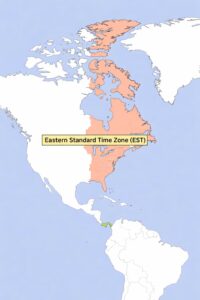
🌎 Eastern Time (ET) – Complete Overview
Eastern Standard Time (EST) is the easternmost primary time zone in North America, covering major population and financial centers across the United States and Canada.It operates at UTC−5 during standard time (EST) and shifts to UTC−4 during daylight saving time (EDT).
The term Eastern Time (ET) is commonly used to refer to both EST and EDT collectively.
📍 Key Highlights
- The most populous time zone in the United States
- Includes major cities like New York, Washington D.C., and Toronto
- Covers nearly half of the U.S. population
- Widely used in Canada, the Caribbean, and parts of Central America
💼 Why Eastern Time Matters
Eastern Time is the global benchmark for finance and media. The New York Stock Exchange (NYSE) operates on ET, making it one of the most important time zones for global markets, business coordination, and international communication.
EST is observed from the first Sunday of November to the second Sunday of March.
During warmer months, clocks shift forward to EDT (UTC−4) as part of Daylight Saving Time.
Geographically, Eastern Time lies between Atlantic Time (AST) and Central Time (CT). It is:
- 1 hour ahead of Central Time (CT)
- 2 hours ahead of Mountain Time (MT)
- 3 hours ahead of Pacific Time (PT)
❓ Frequently Asked Questions
1. What does EST stand for and what is its UTC offset?
EST stands for Eastern Standard Time. It is UTC−5, and during summer it becomes EDT (UTC−4).
2. Which major cities use Eastern Time?
Major cities include New York City, Washington D.C., Toronto, Miami, and Atlanta.
3. When does EST change to EDT?
Clocks move forward on the second Sunday of March and move back on the first Sunday of November.
4. Do Washington D.C. and Toronto share the same time?
Yes, both cities operate under the Eastern Time Zone and remain synchronized throughout the year.
5. Is the NYSE based on Eastern Time?
Yes, the New York Stock Exchange (NYSE) follows Eastern Time. Trading hours are typically 9:30 AM to 4:00 PM ET.